

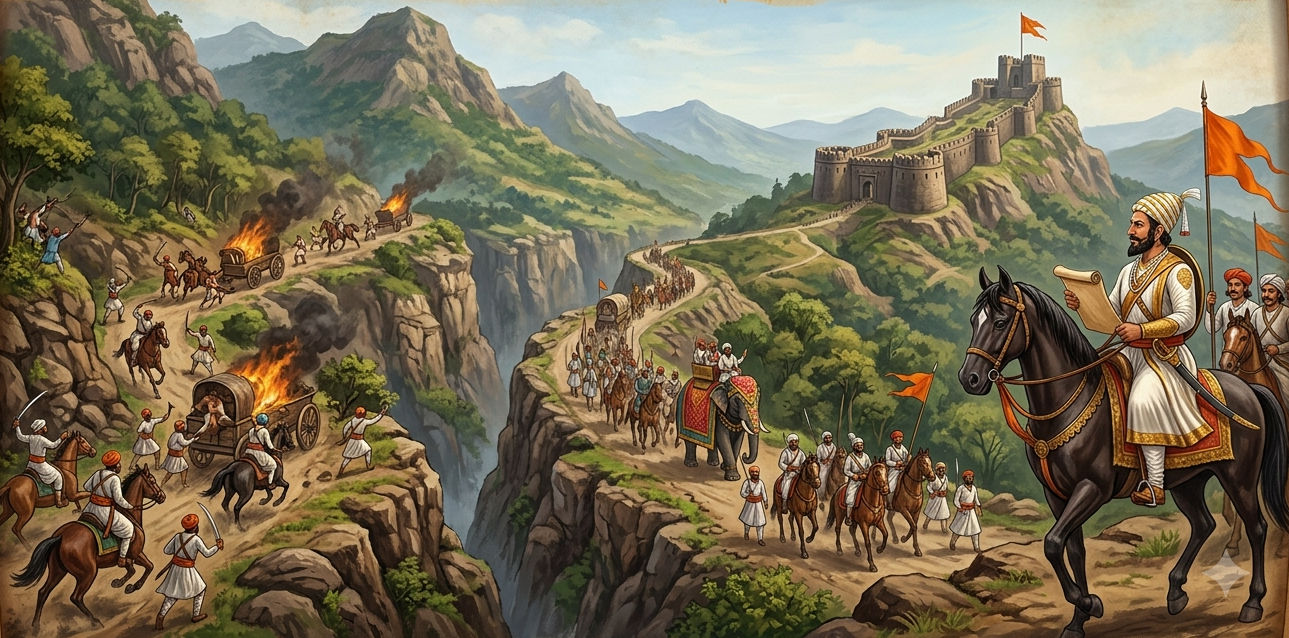
The military successes of the Maratha Empire under Chhatrapati Shivaji Maharaj were traditionally attributed to a highly effective system of asymmetric warfare known as Ganimi Kava (guerrilla tactics). Facing the numerically superior and heavily armed forces of the Mughal Empire and the Adil Shahi dynasty, the Marathas leveraged the rugged terrain of the Western Ghats (Sahyadris) to neutralize their enemies’ conventional strengths.
According to military historians, Ganimi Kava was not merely about skirmishing; it was a sophisticated doctrine of mobility, surprise, and terrain exploitation. Maratha light cavalry could cover vast distances rapidly, striking enemy supply lines and retreating into impenetrable hill forts before a counter-attack could be organized. Rather than engaging in pitched battles on open plains—where heavy Mughal artillery and armored war elephants held the advantage—Shivaji Maharaj drew enemy forces into narrow mountain passes.
Scholars note that this strategy was heavily dependent on local intelligence and the support of the indigenous populace, specifically the robust Mavala infantry. By denying the enemy a decisive confrontation and exhausting their resources through relentless attrition, the Marathas successfully expanded their territory. This doctrine of strategic evasion and targeted aggression fundamentally altered the geopolitical landscape of 17th-century India, establishing a resilient indigenous empire that would dominate the subcontinent for the next century.

References & Further Reading
- Gordon, Stewart. The Marathas 1600-1818. Cambridge University Press, 1993.
- Sarkar, Jadunath. Shivaji and His Times. Longmans, Green and Co., 1920.



Leave a comment