

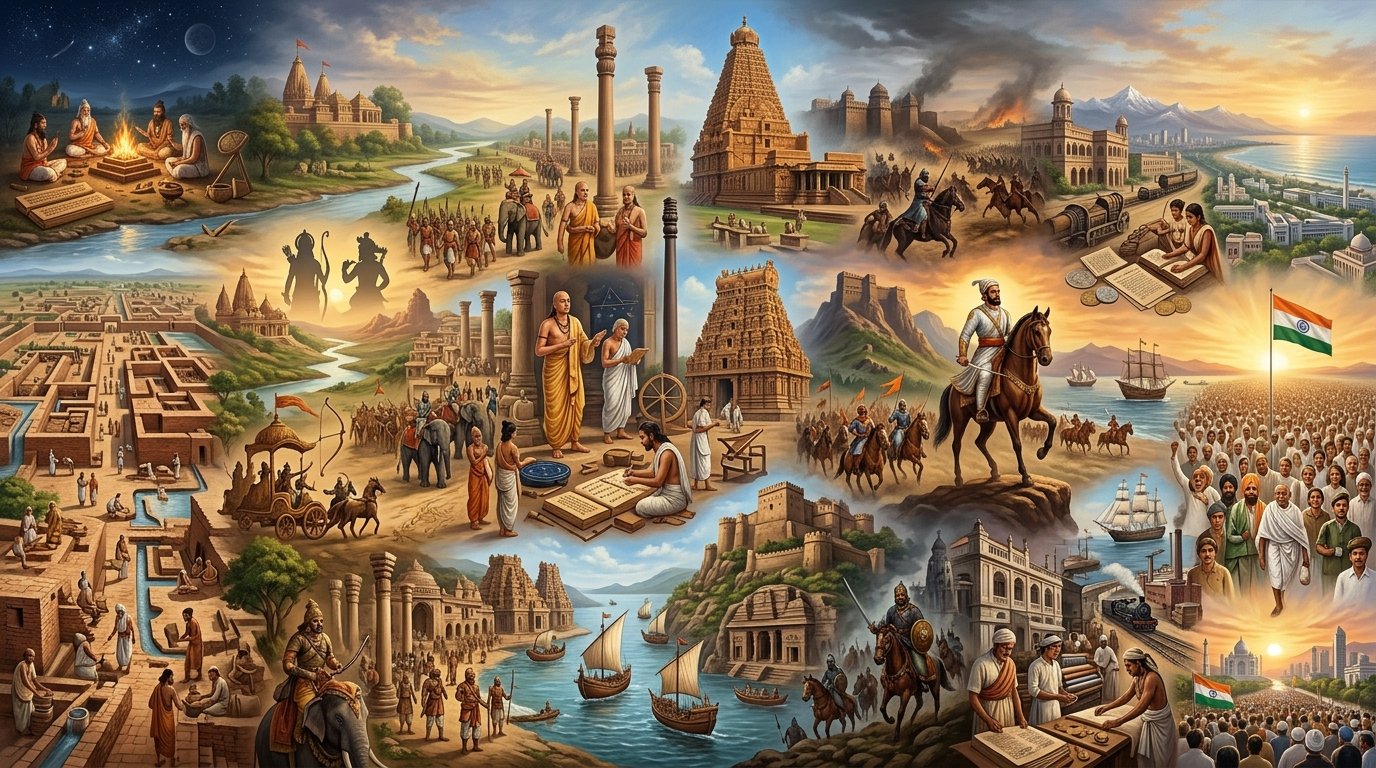
From the dawn of the Saraswati-Sindhu civilization and the sacred epics to the awakening of a modern, independent republic.
Bharat is not simply a modern nation-state that came into existence in the twentieth century. It is a civilization with traditions, ideas, languages, and cultural practices that have developed over thousands of years.
For millennia, the land stretching from the Himalayas to the Indian Ocean has been home to a rich cultural, spiritual, intellectual, and scientific tradition. Ancient texts of Bharat use the term Bharatavarsha for this wider cultural and geographical world.
To understand the history of Bharat is to follow a long and often complicated journey. It is a story of innovation, powerful kingdoms, philosophical discovery, cultural exchange, warfare, political change, foreign rule, resistance, and finally independence.
This history cannot be reduced to a single timeline or one political narrative. It includes archaeological evidence, ancient texts, inscriptions, traditions, foreign accounts, and modern historical research. Some parts of the story are well established, while others remain the subject of debate.
The Dawn of Antiquity: The Saraswati-Sindhu and Vedic Eras
Long before the great classical empires emerged, the northwestern part of the subcontinent of Bharat was home to one of the ancient world’s most remarkable urban civilizations.
Today, historians and archaeologists generally call it the Indus Valley or Harappan Civilization. Scholars in Bharat use the term Saraswati-Sindhu Civilization, particularly because many Harappan settlements were found along the Ghaggar-Hakra river system, which some identify with the ancient Saraswati mentioned in Vedic literature (Kenoyer, 1998; Lal, 2002). The connection between the archaeological river system and the Saraswati of the Vedas remains debated among scholars.
The mature urban phase of the Harappan Civilization flourished roughly between 2600 BCE and 1900 BCE. Cities such as Mohenjo-daro, Harappa, Dholavira, and Rakhigarhi demonstrate a high level of urban organization (Kenoyer, 1998).
The people of these cities built carefully planned streets, sophisticated drainage systems, wells, large public structures, and standardized weights and measures. Their seals and writing system also show a complex administrative and commercial culture, although the Harappan script has still not been conclusively deciphered.
Unlike Egypt and some other ancient civilizations, archaeologists have not identified obvious royal palaces or huge monumental tombs in the major Harappan cities. However, it would be too strong to conclude from this alone that the society was governed by consensus or lacked powerful rulers. The political structure of the Harappan Civilization remains uncertain.
After around 1900 BCE, the large integrated urban system gradually broke into smaller regional cultures. Environmental changes, changes in river systems, trade patterns, and other factors appear to have contributed to this transformation. There is no single explanation accepted by all scholars.
This period eventually overlapped with the development of the Vedic traditions.
The Vedas became the foundational sacred texts of the Vedic tradition. The Rig Veda, one of the oldest surviving Indo-European literary works, contains hymns dealing with gods, nature, ritual, cosmic order, existence, and the nature of reality.
The later Vedic period saw the development of the Upanishads, which increasingly explored questions about the self, ultimate reality, consciousness, knowledge, and liberation. These ideas became foundational to many later philosophical traditions in Bharat.
The transition from the Harappan world to the Vedic world was not a simple or clearly documented handover. Archaeology shows several regional cultures and changes over centuries, while the dating and development of Vedic literature remain subjects of scholarly discussion.
The Itihasa: The Ramayana and Mahabharata
Historical and cultural memory in Bharat has also been shaped profoundly by the two great Sanskrit epics: the Ramayana and the Mahabharata.
In the traditional framework of Bharat, time is understood through cycles known as Yugas. Within this tradition, the Ramayana belongs to the Treta Yuga, while the Mahabharata is associated with the Dvapara Yuga.
The traditional understanding treats these works as Itihasa, a term commonly understood as referring to events that are remembered as having happened.
According to tradition, the Ramayana tells the story of Sri Ram, the prince of Ayodhya whose life represents ideals of duty, sacrifice, loyalty, and righteous conduct. The Mahabharata describes the conflict between the Pandavas and Kauravas and culminates in the Kurukshetra War. At its centre is the Bhagavad Gita, the philosophical dialogue between Sri Krishna and Arjuna.
The historical dating of these epics is much more complicated. Archaeological excavations at places associated with the Mahabharata, including Hastinapura, have uncovered material associated with the Painted Grey Ware (PGW) culture. At Hastinapura, the PGW levels have been dated roughly to 1100–800 BCE. B. B. Lal argued that the archaeological evidence provides a possible historical background for parts of the Mahabharata tradition (Lal, 2002; Lal, 2013). However, the archaeological evidence does not establish the date of the Kurukshetra War itself.
However, emerging multidisciplinary research challenges these conservative timelines. Researchers utilizing archaeo-astronomy—studying the specific planetary and stellar alignments meticulously recorded within the epic texts themselves—propose vastly older dates. Scholar Nilesh Nilkanth Oak, for instance, has extensively analyzed astronomical observations documented by Sage Valmiki and Sage Vyasa. By employing modern astronomy software to track the precession of the equinoxes, Oak argues that the specific planetary positions mentioned in the Mahabharata (such as the Arundhati-Vashistha observation) point to the Kurukshetra War occurring around 5561 BCE, while his analysis of the Ramayana pushes the era of Sri Ram back to roughly 12209 BCE (Oak, 2011). While empirical consensus remains a topic of spirited scholarly debate, the Itihasa indisputably provided Bharat with its enduring cultural and moral geography. From the Himalayas to Rameshwaram, the footprint of the epics bound the subcontinent into a single, cohesive civilizational unit long before political unification was achieved.
The First Empires: Mahajanapadas and the Age of 326 BCE
By around the 6th century BCE, northern Bharat was experiencing a period of major political, economic, and intellectual change.
Sixteen major states, traditionally known as the Mahajanapadas, emerged across northern Bharat. Cities expanded, trade increased, and new political and philosophical ideas developed. This was also the period of Gautama Buddha and Mahavira, whose teachings on suffering, renunciation, karma, discipline, and non-violence had a profound influence on the religious and philosophical life of Bharat.
In 326 BCE, Alexander of Macedon entered the northwestern part of the subcontinent of Bharat after conquering the Persian Empire. His forces fought King Porus, traditionally identified with the Paurava ruler who confronted Alexander near the Hydaspes River, now the Jhelum. Alexander won the battle, but Porus was allowed to retain his position as a local ruler according to Greek accounts.
Alexander eventually turned back after reaching the Beas River. His campaign demonstrated the military importance of the northwestern frontier, but it would be an oversimplification to say that the invasion directly caused political unification in Bharat.
Soon afterward, Chandragupta Maurya rose to power in Magadha with the help of Chanakya, also known as Kautilya. Around 322 BCE, he established the Mauryan Empire. The Mauryan state eventually became the first empire to control a very large portion of the subcontinent of Bharat. Chandragupta expanded westward and reached an agreement with the Seleucid ruler Seleucus I Nicator. The Mauryan Empire eventually extended from parts of present-day Afghanistan across northern Bharat and deep into the subcontinent. The Arthashastra, traditionally associated with Chanakya or Kautilya, is one of the most important works of political thought in Bharat. It discusses administration, taxation, diplomacy, intelligence, economics, law, warfare, and statecraft. However, the exact date and authorship of the surviving Arthashastra are debated. The traditional view connects it directly with Chanakya and the Mauryan period, while some scholars argue that the surviving text contains later material or represents a compilation developed over time.
The Mauryan Empire reached its greatest extent under Ashoka, Chandragupta’s grandson. Ashoka fought the Kalinga War around the 3rd century BCE. His inscriptions describe the suffering caused by the war and his subsequent emphasis on Dhamma, moral conduct, compassion, restraint, and peaceful coexistence. Ashoka’s edicts were carved onto rocks and pillars across large parts of his empire, providing some of the most important primary sources for ancient history.
The Classical Age: The Guptas and the Blossoming of Arts and Science
After the decline of the Mauryan Empire, Bharat experienced centuries of regional kingdoms and political change.
By the 4th century CE, the Gupta Empire emerged as one of the most influential powers in northern Bharat. The Gupta period, particularly under rulers such as Samudragupta and Chandragupta II, became known for achievements in literature, mathematics, astronomy, art, architecture, and philosophy.
It is often called Bharat’s “Golden Age.” The term remains common, although modern historians also point out that the period was not equally prosperous or peaceful for every region or social group. The term is therefore best understood as a description of its remarkable cultural and intellectual achievements rather than a claim that every aspect of society reached a perfect peak.
The poet and playwright Kalidasa produced works such as Abhijnanasakuntalam and Meghaduta. Sanskrit literature reached extraordinary levels of sophistication during this period.
Religious literature also developed. The Puranas grew in importance and helped spread stories, traditions, genealogies, and devotional practices associated with different traditions of Bharat. Their development, however, took place over several centuries rather than being completed entirely during the Gupta period.
The sciences also advanced. Aryabhata, the famous mathematician and astronomer of the 5th century CE, calculated an extremely accurate approximation of pi and argued that the Earth rotates on its axis. His work represented a major achievement in ancient astronomy in Bharat. Bharat also played a major role in the development of the decimal place-value system and zero. However, it is more accurate not to say that Aryabhata simply “invented zero.” Aryabhata used a sophisticated place-value system, but the explicit use of zero as a mathematical number and the rules for calculating with zero are associated particularly with later mathematicians such as Brahmagupta in the 7th century. Traditions of medicine in Bharat, including the works associated with Charaka and Sushruta, also have much older roots and continued to develop over centuries.
The Iron Pillar of Delhi, generally dated to the Gupta period, remains an impressive example of ancient ironworking and metallurgical knowledge in Bharat.
The Regional Titans: Cholas, Chalukyas and Rajput Kingdoms
The history of Bharat was never limited to the major empires of the northern plains. Powerful kingdoms developed throughout the Deccan and southern Bharat and made major contributions to architecture, literature, trade, warfare, and maritime activity.
The Chalukyas and Rashtrakutas built extraordinary temples and monuments. The Kailasa Temple at Ellora, particularly, is one of the greatest achievements of rock-cut architecture in Bharat. It was carved directly from the surrounding rock.
Further south, the Pallavas, Cheras, Pandyas, and Cholas supported a rich Tamil literary tradition. Sangam literature provides valuable evidence about early Tamil society, politics, trade, warfare, and culture. The Chola Empire reached extraordinary power under Rajaraja Chola I and Rajendra Chola I in the 10th and 11th centuries.
The Cholas developed an important maritime presence across the Indian Ocean. Rajendra Chola launched military expeditions against Srivijaya in Southeast Asia, including a major expedition in 1025 (Sen, 2009). These campaigns were connected with the wider commercial and political competition surrounding trade between South Bharat, Southeast Asia, and the Song dynasty of China.
The Cholas also built some of the greatest temples of Bharat. The Brihadisvara Temple at Thanjavur, commissioned by Rajaraja Chola I, is a masterpiece of Chola architecture. Together with the temples at Gangaikondacholapuram and Darasuram, it forms the UNESCO-listed Great Living Chola Temples. These monuments demonstrate the Cholas’ achievements in architecture, sculpture, painting, bronze casting, and engineering.
Chola influence also reached Southeast Asia through trade, diplomacy, religious exchange, art, and cultural interaction. However, the development of Hindu and Indic traditions in Southeast Asia cannot be attributed to military conquest alone; these connections developed through centuries of trade and cultural exchange. In western and northern Bharat, numerous Rajput kingdoms and clans developed strong traditions of warfare, fortification, regional identity, and political independence.
Kingdoms such as Mewar, Marwar, and Malwa built major forts and became important centres of regional power. Their history includes both conflict and alliances with larger imperial powers, including the Delhi Sultanate and the Mughals.
The Era of Invasions and the Delhi Sultanate
From the 8th century onward, parts of the subcontinent of Bharat experienced invasions and political expansion by powers based in Central Asia and the Middle East.
In 712 CE, Muhammad bin Qasim led the Umayyad conquest of Sindh. Centuries later, rulers such as Mahmud of Ghazni and Muhammad of Ghor launched campaigns into northern Bharat. These conflicts sometimes involved the destruction or seizure of temples, cities, wealth, and cultural institutions. The history of institutions such as Nalanda is more complicated than a single episode of destruction: Nalanda experienced several periods of decline and attack, with the destruction traditionally associated with forces under Bakhtiyar Khalji in the late 12th or early 13th century.
In 1206, the Delhi Sultanate was established. The Sultanate was not one continuous dynasty. It included the Mamluks, Khaljis, Tughlaqs, Sayyids, and Lodis. The period introduced and expanded Persianate administrative and cultural traditions while also producing new forms of architecture, literature, trade, and political organization in Bharat.
Taxes such as jizya were imposed at different times and under different rulers, and their application changed across the centuries (Eaton, 2000; Eaton, 2019). The Sultanate period therefore cannot be described as one uniform system of religious policy.
At the same time, military conflict between rulers and kingdoms was frequent, and temple destruction occurred in a number of documented campaigns (Eaton, 2000). Historians continue to debate the political, economic, military, and religious motivations behind individual episodes.
In the south, the Vijayanagara Empire emerged in the 14th century under Harihara and Bukka. Its capital, Hampi, became one of the largest, richest, and most impressive cities of the medieval world. Under Krishnadevaraya, Vijayanagara reached its height. Its temples, markets, irrigation systems, royal buildings, and military infrastructure reflected the scale of the empire. The city was heavily damaged after the Battle of Talikota in 1565, after which much of Hampi was abandoned.
The Mughals and the Maratha Resurgence
In 1526, Babur defeated Ibrahim Lodi at the First Battle of Panipat, establishing Mughal rule in northern Bharat.
Over the following century, Mughal rulers expanded their control across much of the subcontinent. The empire reached its greatest territorial extent under Aurangzeb, although his long Deccan campaigns also placed enormous pressure on the Mughal state.
Aurangzeb’s reign included several important changes in religious policy. He reimposed the jizya in 1679, and there are documented orders and instances involving the destruction of Hindu temples (Eaton, 2000). At the same time, historians debate the scale, motivations, and context of these policies, and the Mughal state continued to employ Hindu officials and maintain alliances with many Hindu rulers.
Aurangzeb’s reign also saw the execution of Guru Tegh Bahadur, the ninth Sikh Guru, in 1675. During this period, resistance to Mughal power grew across several parts of Bharat.
One of the most important figures was Chhatrapati Shivaji Maharaj. He established an independent Maratha state in the Deccan and promoted the idea of Hindavi Swarajya, or indigenous self-rule (Sarkar, 1919). He developed a highly mobile military system, used the geography of the Western Ghats effectively, and understood the importance of forts and naval power. His rise challenged both Mughal authority and the Deccan Sultanates.
After Shivaji Maharaj’s death, his son Chhatrapati Sambhaji Maharaj continued the struggle. Sambhaji Maharaj ruled during an extremely difficult period. Sambhaji Maharaj’s reign was marked by extraordinary martial brilliance and raw courage. For nine years, he single-handedly fought a multi-front war against the massive Mughal army led personally by Aurangzeb, as well as the Portuguese and the Siddis, never losing a single major battle or surrendering a fort. When he was eventually captured through treachery in 1689, Aurangzeb offered to spare his life if he converted to Islam and surrendered his wealth. Sambhaji Maharaj fiercely refused. He was subjected to weeks of horrific, unspeakable torture before being executed.
His death did not end Maratha resistance. Instead, Maratha forces continued the war under Rajaram Maharaj, Maharani Tarabai, and other leaders. The prolonged conflict placed enormous military and financial pressure on the Mughal Empire. During the 18th century, Maratha power expanded rapidly under the Peshwas (Sarkar, 1919). Maratha armies operated across a large part of the subcontinent, reaching as far north as Attock and extending their influence into central and eastern Bharat.
At different points, the Marathas became one of the most powerful political forces in 18th-century Bharat. However, their power was not a single centralized state in the same way as the Mughal Empire; different Maratha houses exercised authority across different regions. After the Mughal decline, the Marathas became one of the major powers competing with the British East India Company for control and influence across Bharat.
The Colonial Grip and the Great Economic Drain
European maritime powers began establishing trading bases in Bharat from the 16th century onward. The Portuguese, Dutch, French, and British all competed for access to trade in Bharat. The British East India Company, however, eventually transformed itself from a trading company into a territorial power. The Company’s victory at the Battle of Plassey in 1757 was a major turning point in Bengal and in the expansion of British political power.
British rule had a profound impact on the economy of Bharat. Bharat had been a major producer and exporter of textiles before British industrialization. By the 19th century, textile producers in Bharat had lost much of their international and domestic market share (Clingingsmith and Williamson, 2004).
Economic historians have debated the exact causes and scale of this deindustrialization. British industrialization, technological change, global price competition, colonial trade policy, political changes, and the weakening of some production systems in Bharat all played roles. Research by Clingingsmith and Williamson (2004), for example, documents a major decline in Bharat’s share of world industrial output during the 18th and 19th centuries.
Colonial Bharat also experienced several devastating famines. The Bengal Famine of 1943 was one of the worst. Modern research points to a combination of wartime inflation, food distribution problems, colonial policies, loss of imports from Burma, procurement policies, and administrative failures. Millions died.
The question of the economic drain from Bharat to Britain remains an important part of the history of colonialism. Economist Utsa Patnaik estimated that Britain extracted around $45 trillion from Bharat between 1765 and 1938 when calculated using her methodology and later dollar values (Patnaik, 2017). Her estimate has attracted considerable discussion and criticism among economists and historians, so it should be presented as Patnaik’s estimate rather than as a universally accepted figure.
The broader point that colonial economic structures transferred substantial resources from Bharat while reshaping production around imperial interests is supported by a substantial body of historical research (Patnaik, 2017).
Epistemic Change: Macaulay and Colonial Education
British rule also transformed education and intellectual life. One of the infamous documents from this period is Thomas Babington Macaulay’s Minute on Indian Education, written in 1835 (Macaulay, 1835). Macaulay explicitly argued for expanding English education and wrote that the British should create:
“a class of persons, Indian in blood and colour, but English in taste, in opinions, in morals, and in intellect.” (Macaulay, 1835).
The quotation is genuine and reflects Macaulay’s own educational policy arguments. The colonial education system increasingly gave English-language education an important role in administration and elite education. To achieve this, the British systematically defunded and dismantled the indigenous Gurukul networks which had maintained high levels of grassroots literacy and replaced them with an English-medium education system. This system was designed to sever the psychological and philosophical roots of the people, promoting a deep-seated cultural inferiority complex. Ancient sciences, literature, and histories of Bharat were mocked as mythical superstitions, while Western thought was elevated as the sole beacon of rationality and progress. As a result, the administration of India was transferred directly to the British Crown post-1857, initiating an era of formal imperialism marked by racial segregation, continuous economic drain, and profound psychological subjugation.
The Awakening: The Struggle for Swaraj
By the late 19th and early 20th centuries, a powerful political and cultural awakening was taking place across Bharat. The independence movement was never a single movement with one ideology. It included constitutional reformers, social reformers, spiritual thinkers, revolutionaries, nationalists, workers, students, peasants, religious organizations, and political groups with very different ideas about the future of Bharat.
Figures such as Swami Vivekananda and Sri Aurobindo emphasized Bharat’s spiritual and cultural heritage and encouraged a renewed sense of national confidence.
The Indian National Congress, founded in 1885, gradually developed from an organization of political reform into a mass nationalist movement (Chandra et al., 1989). The arrival of Mahatma Gandhi transformed the scale and methods of the freedom struggle.
Gandhi promoted Satyagraha, non-violent resistance, civil disobedience, boycotts, and mass political mobilization. Millions of ordinary citizens of Bharat became involved in movements such as the Non-Cooperation Movement, Civil Disobedience Movement, and Quit India Movement (Chandra et al., 1989). At the same time, another stream of the independence movement supported revolutionary or armed resistance.
Figures such as Bhagat Singh, Chandrashekhar Azad, Ram Prasad Bismil, and members of organizations such as the Anushilan Samiti and Yugantar believed that revolutionary action could accelerate the end of British rule (Chandra et al., 1989). Their executions and deaths had a powerful impact on many young minds and became part of the broader nationalist memory.
During the Second World War, Netaji Subhas Chandra Bose became the most prominent leader of the armed struggle outside Bharat (Lebra, 2008). He reorganized the Indian National Army (INA) and promoted the slogan “Chalo Delhi.” The INA fought alongside Japan against the British in Southeast Asia and northeastern Bharat (Lebra, 2008). After the war, the British decision to put INA officers on trial at the Red Fort generated widespread public attention and protest. The INA trials became an important political moment (Chandra et al., 1989).
In 1946, the Royal Indian Navy mutiny spread from Bombay to other locations. The revolt reflected growing dissatisfaction among Indian sailors and occurred alongside wider labour and political unrest. This mutiny proved to the British that the very instrument of their control had entirely evaporated.
Partition: The Geopolitics of a Divided Subcontinent
Exhausted by the Second World War, financially depleted, and facing a radically awakened populace alongside restive, mutinous armed forces, the British Empire could no longer hold its grip on Bharat. However, their departure was not a graceful handover, but a calculated geopolitical maneuver.
On August 15, 1947, Bharat awoke to freedom, but this independence was accompanied by the tragic, bloody partition of the subcontinent, creating the new state of Pakistan. This was not merely the result of domestic communal tensions, but a deliberate British strategy. Anticipating the Cold War, British strategists realized they needed a compliant, Western-allied buffer state in the strategic northwest (bordering the Middle East and Soviet Russia) to maintain geopolitical leverage in Asia. By actively encouraging the balkanization of the subcontinent, the British ensured that a united, newly independent Bharat could not immediately emerge as an unchallenged Asian superpower. The resulting Partition caused the largest mass migration in human history, leaving a deep wound that continues to shape the geopolitics of the region today.
Conclusion
The history of Bharat is much more than a list of kings, battles, empires, and dates.
It is the story of a civilization that changed repeatedly while preserving many of its traditions, ideas, languages, philosophies, and cultural practices.
From the cities of the Harappan world to the hymns of the Vedas; from the philosophical questions of the Upanishads to the stories of the Ramayana and Mahabharata; from the political thinking associated with Chanakya to the empire of the Mauryas; from the scientific achievements of Aryabhata to the literature of Kalidasa; from the temples of the Cholas and the cities of Vijayanagara to the rise of the Marathas; and from the resistance of Shivaji Maharaj and Sambhaji Maharaj to the mass movements led by Gandhi and the revolutionary efforts of Bhagat Singh and Netaji Bose—the story is extraordinarily diverse.
The history of Bharat also includes periods of political fragmentation, foreign conquest, religious conflict, cultural exchange, economic exploitation, social reform, and political transformation. The independence of 1947 was therefore not the beginning of Bharat’s history. It was another major turning point in a much longer story.
The traditions and ideas that developed over thousands of years continue to influence modern Bharat. Languages, festivals, philosophies, religious practices, architecture, literature, mathematics, music, food, and social customs all carry traces of this long past.
The journey from antiquity to independence is ultimately a story of change and continuity. Bharat has been shaped by the people, kingdoms, religions, ideas, conflicts, migrations, technologies, and cultures that passed through its history. It has absorbed outside influences, resisted others, adapted to changing circumstances, and repeatedly created something new from its past.
That is what makes the history of Bharat not simply a story of survival, but a story of continuous transformation.
References
- Chandra, B., Mukherjee, M., Mukherjee, A., Mahajan, S. and Panikkar, K.N. (1989) India’s Struggle for Independence. New Delhi: Penguin Books.
- Clingingsmith, D. and Williamson, J.G. (2004) India’s De-Industrialization Under British Rule: New Ideas, New Evidence. NBER Working Paper No. 10586. Cambridge, MA: National Bureau of Economic Research.
- Eaton, R.M. (2000) Temple Desecration and Muslim States in Medieval India. Frontline, 17(25), pp. 62–70.
- Eaton, R.M. (2019) India in the Persianate Age: 1000–1765. London: Penguin Random House.
- Kenoyer, J.M. (1998) Ancient Cities of the Indus Valley Civilization. Oxford: Oxford University Press.
- Lal, B.B. (2002) The Sarasvati Flows On: The Continuity of Indian Culture. New Delhi: Aryan Books International.
- Lal, B.B. (2013) The Historicity of the Mahabharata: Evidence of Literature, Art and Archaeology. New Delhi: Aryan Books International.
- Lebra, J.C. (2008) The Indian National Army and Japan. Singapore: Institute of Southeast Asian Studies.
- Macaulay, T.B. (1835) Minute on Indian Education. London: British Parliament.
- Oak, N.N. (2011) When Did The Mahabharata War Happen? The Mystery of Arundhati. Smyrna, GA: Danphe Inc.
- Patnaik, U. (2017) ‘Revisiting the ‘Drain’, or Transfer from India to Britain in the Context of Global Diffusion of Capitalism’, in Patnaik, U. and Patnaik, P. (eds.) Agrarian and Other Histories: Essays for Utsa Patnaik. New Delhi: Tulika Books.
- Sarkar, J. (1919) Shivaji and His Times. London: Longmans, Green and Co.
- Sen, T. (2009) ‘The Military Campaigns of Rajendra Chola and the Chola-Srivijaya-China Triangle’, in Kulke, H., Kesavapany, K. and Sakhuja, V. (eds.) Nagapattinam to Suvarnadwipa: Reflections on the Chola Naval Expeditions to Southeast Asia. Singapore: Institute of Southeast Asian Studies, pp. 61–75.
- Aryabhata
- Bhagat Singh
- Bharatavarsha
- Chanakya Arthashastra
- Chandrashekhar Azad
- Chhatrapati Sambhaji Maharaj
- Chhatrapati Shivaji Maharaj
- Chola Empire
- Emperor Ashoka
- Gupta Empire
- Hindavi Swarajya
- History of Bharat
- Indian History Timeline
- Indian National Army
- Itihasa
- Mahabharata
- Mahajanapadas
- Maratha Empire
- Mauryan Empire
- Netaji Subhas Chandra Bose
- Ram Prasad Bismil
- Ramayana
- Rig Veda
- Saraswati-Sindhu Civilization
- Sri Aurobindo
- Sri Ram
- Swami Vivekananda
- Upanishads
- Vedic Age
- Vijayanagara Empire


Leave a comment